
I Traded a Team of AI Bots for One AI Assistant. Here's What Changed
I ran a team of AI bots, then switched to one AI assistant. A week-one field report on what changed: memory, overhead, and where each one actually fits.

A few months ago I wrote about giving my small business a team of AI bots. That post is still up, and I am leaving it up. It was true when I wrote it.
The facts moved. The work did not stop. I just do it a different way now.
In early November I moved from a team of bots to one AI assistant. Same business. Same jobs piling up. One place to go instead of a roster to manage.
That was November 2. So this is early. A little over a week in, not a year. This is not a victory lap. It is a field report from the switch, and I will update it when I have a full month behind me.
Here is what I learned running both, and where each one actually fits.
What a Team of Bots Actually Is
In my old setup, each bot had a job. One was my main assistant. One acted as a chief of staff and prepped my mornings. Others had narrower roles.
They shared one knowledge base in Google Drive. That mattered. Without it, I would have explained the same thing three times.
That model works. I want to be clear about that before I explain why I left it. A bot with one clear job, clear rules, and a shared place to look things up can do real work.
It also has a cost that is not money. You are managing a small team. Every bot needs its role kept current. Every correction has to land in the shared notes, or only one bot learns it. When something goes wrong, the first question is which bot was supposed to handle it.
For a solo business, that overhead adds up fast.
What One Assistant Actually Is

My current setup is simpler to describe. I work with one assistant, Moss, as my chief of staff.
I talk to Moss in one place. Moss keeps a memory of how I work, what I decided, and what I corrected. When I fix something once, I expect it to stay fixed.
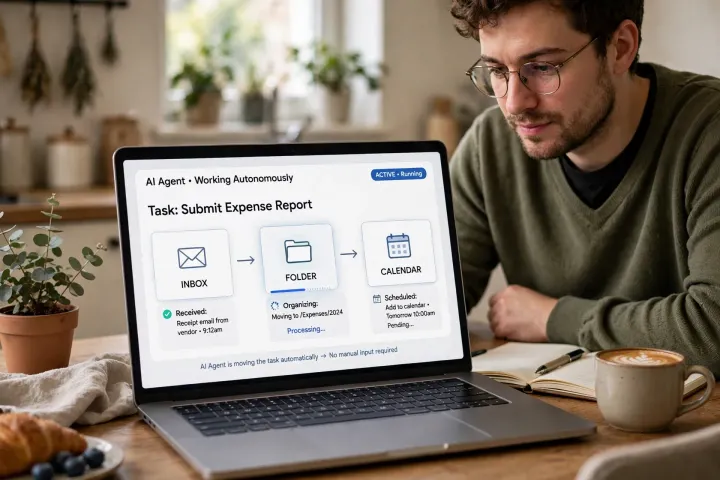
The bigger difference is tools. A chatbot talks about work. An assistant does work in the tools I already use, with my permission. Email. Files. Calendar. Drafts I can check before anything goes out.
That does not make it magic. It makes it accountable. I can ask where an answer came from. I can check the file, the message, or the date myself. If Moss cannot verify something, I want to hear that plainly, not get a confident guess.
The Comparison That Matters
Memory. With a team, memory lives in a shared knowledge base that someone has to maintain. That someone was me. With one assistant, memory is part of the job. Corrections are kept, decisions are kept, and so far, I repeat myself a lot less.
Action. A bot that only chats can still help you think. But most of my work is not thinking out loud. It is triage, drafts, files, schedules, and follow through. One assistant connected to real tools finishes more of that work end to end.
Context. A roster splits context. Each bot sees its slice. One assistant sees how the slices connect, because my business is not actually separate departments. A stream, a blog post, a sponsor question, and my calendar all touch each other.
Overhead. This is the one I underestimated. Fewer moving parts means fewer roles to define, fewer notes to sync, and fewer places for an old instruction to hide.
Cost. In the Grok era, my setup ran on a Grok Super plan at $100 a month, on a shared weekly usage pool that also covered other tools. I am not going to publish a neat comparison number for the current setup yet. I am tracking a full month first. I will post the real numbers in December, when the full Guide gets rewritten from that same month of work. That is the honest way to do it.
Failure modes. These are the same in both models, and anyone who tells you otherwise is selling something. Vague asks get vague results. "Work on website" fails with a bot, with an assistant, and with a human. Clear job, clear rules, clear check. That part never changed.
Where Bots Genuinely Fit Better
I am not done with bots as an idea, and I would not tell anyone else to be done with them either.
A separate bot makes sense when a job is fixed and isolated. Same input, same steps, same output, over and over. It also makes sense when you want a second opinion from a different system, on purpose. And it makes sense when you want work kept separate for privacy or safety reasons.
If a job is truly separate, a separate bot is a clean way to keep it separate.
Most of my jobs were not separate. That was the mismatch. I built a team structure for work that needed one memory and one thread.
Where an Assistant Fits Better
An assistant fits better when the work crosses tools. Read the inbox, check the calendar, find the file, draft the reply, and hold the decision until I make it. That is a chain, not a single step.
It also fits better when the work depends on history. What did I decide last week? What did I correct last time? What is still open? If the answer lives in one memory, I spend less time re-explaining and more time deciding.
And it fits better when judgment matters more than volume. I do not need a thousand outputs. I need the right draft, the right flag, and a clear next step I can say yes or no to.
The Rules Did Not Change
The tool changed. My rules did not.
Drafts first. Nothing is final on the first pass.
Nothing gets sent or posted without my yes. No email, no post, no message.
A person approves anything risky. Money, public posts, deleting things, anything hard to undo.
Secrets never go in chat. Passwords and keys stay in proper storage, not in a conversation.
Start with look, don't touch. Read-only first. Wider access has to be earned by good work on a small job.
Those rules held with a team of bots. They hold now. If you skip them, the model you pick will not save you.
How I Scale Now
I used to think scaling meant adding a bot. New job, new bot, new role to manage.
Now I scale by adding jobs, not bots. When the first job runs well, I hand the same assistant a second job. Then a third, when it has earned it.
That is a slower start and a cleaner finish. One job. One assistant. Clear rules. Check the work. Then expand.
Most people are capable of more than they think. Sometimes all that is in the way is the busywork, and a roster they do not need yet.
Start Where I Started
If you are starting from zero, do not start with a team. Start with one job you do every week that eats time.
The free Start With One Bot checklist walks through it, step by step. One job, one assistant, clear rules, and the guardrails I still use. It is free when you sign up as a Subscriber on grizzlyray.com.
Here's my question: what's one task you'd hand off tomorrow if you could?


Comments ()