
AI Bot vs. Chatbot vs. Automation: What's the Difference?

These three words get thrown around like they mean the same thing. They don't. And if you're a small business owner or a hobbyist trying to pick a tool, the difference matters.
Once you know which is which, you can pick the simplest tool that fits the job and skip what you don't need. Automation follows rules, a chatbot answers, and an AI bot works. Here's what each one actually is, in plain words, and how to pick.
Automation: It Follows the Rules You Set
Automation is the oldest of the three. You set a rule, and it runs the same way every time. "When a form comes in, add it to this spreadsheet." "When an invoice is paid, send a receipt."
What it's good at:
- Doing the exact same thing, the exact same way, every time
- Running in the background without you watching
Where it falls short:
- It doesn't think. If something doesn't fit the rule, it breaks or does the wrong thing quietly.
- Someone has to set it up and keep it updated when your process changes.
If your task looks the same every time, plain automation is often all you need. No AI required.
Chatbot: It Answers When You Ask
A chatbot is the thing you type into. You ask a question, it gives you an answer. That might be an AI chat app, or the help bubble on a website.
What it's good at:
- Explaining things, brainstorming, and first drafts
- Answering the same customer questions over and over
Where it falls short:
- It usually waits for you. It doesn't go do the work on its own.
- It only knows what you give it in that conversation, unless it's connected to more.
A chatbot is a good place to start. Most people meet AI here first.
AI Bot: It Does the Work, With Your Rules
This is the newer one. An AI bot (some people call it an agent) can use the tools you connect, like your files, your calendar, or your task list, and work through a job step by step. It can keep going while you're away.
What it's good at:
- Multi-step jobs, like sorting a pile of email and drafting replies
- Remembering how you like things done, if you write it down for it
- Handing you a draft to review instead of a blank page
Where it falls short:
- It can be confidently wrong. It still needs a person to check the work.
- It needs clear instructions. Vague asks get vague results.
- Because it can act, the rules matter more. I keep mine simple: drafts first, and nothing goes out without my yes.
Side by Side
Here's the same comparison in one place.
| Automation | Chatbot | AI Bot | |
|---|---|---|---|
| What it does | Follows a rule you set | Answers when you ask | Works through a job with the tools you connect |
| Who starts it | A trigger, like a form or a payment | You, by typing a question | You hand it a job, and it can keep going |
| Handles surprises | Not well. It breaks or does the wrong thing quietly | Somewhat, inside the conversation | Better, but it can be confidently wrong |
| Setup | Someone builds and maintains the rules | Little to none | Clear instructions and the right connections |
| Needs a person to check | When the rule or process changes | When the answer matters | Every time something goes out |
| Best for | Tasks that look the same every time | Answers, ideas, and first drafts | Repeated jobs with a few steps that need some judgment |
One Everyday Example, Three Ways
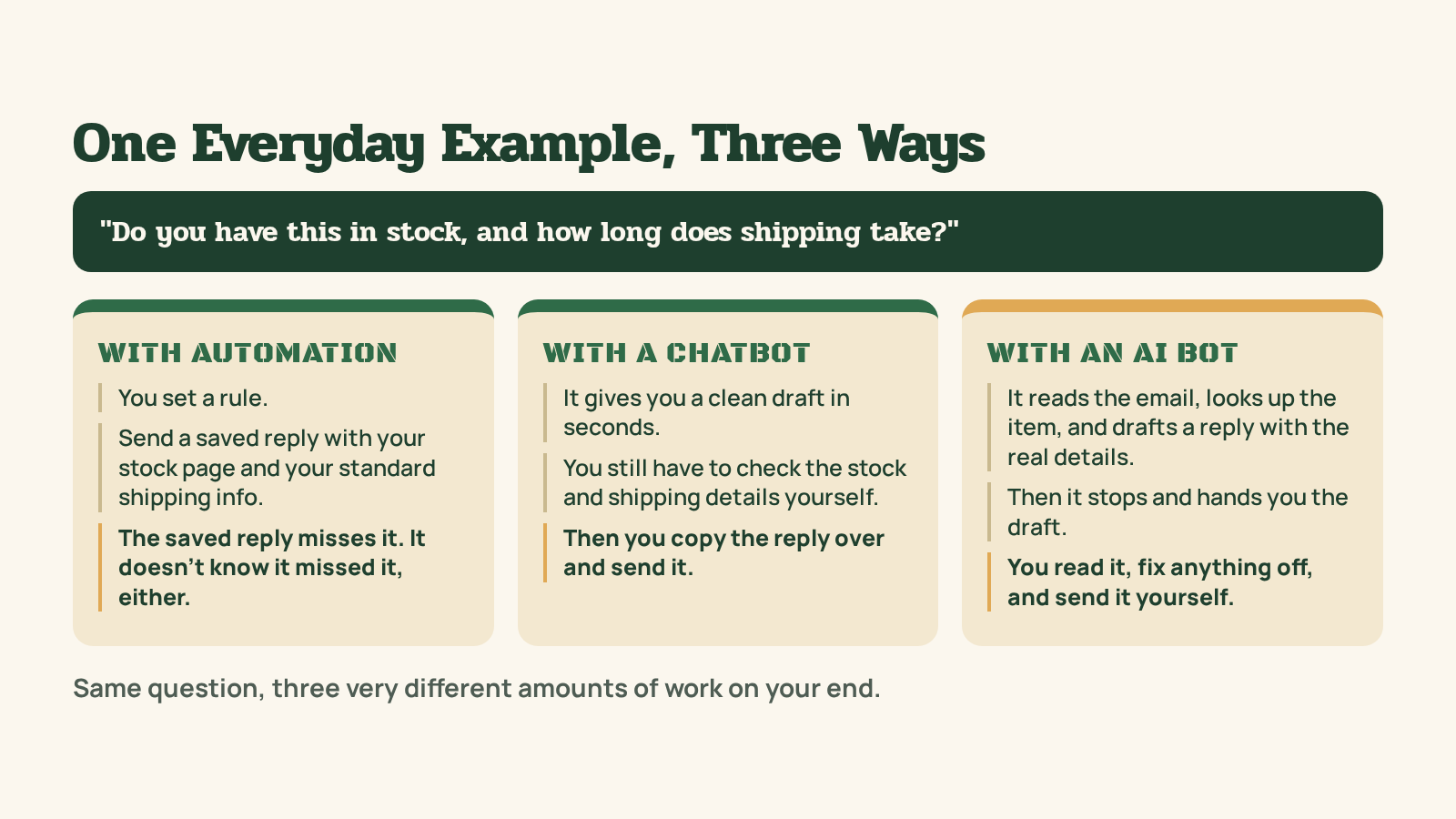
Say a customer emails you a simple question: "Do you have this in stock, and how long does shipping take?" Here's how each tool might handle it. This is a general example, not a setup I'm describing from my own business.
With automation: You set a rule. When an email comes in with certain words in it, send a saved reply with your stock page and your standard shipping info. It's fast and it never forgets. But if the customer also asked about a return, or wrote it in a way the rule doesn't expect, the saved reply misses it. It doesn't know it missed it, either.
With a chatbot: You paste the customer's email into a chat app and ask for a friendly reply. It gives you a clean draft in seconds. You still have to check the stock and shipping details yourself, because it only knows what you told it. Then you copy the reply over and send it.
With an AI bot: You've connected it to your inbox and your product info, and you've written down how you like replies to sound. It reads the email, looks up the item, and drafts a reply with the real details. Then it stops and hands you the draft. You read it, fix anything off, and send it yourself.
Same question, three very different amounts of work on your end. The more the tool does, the more important it is that you're the last step before anything goes to a customer.
Mixing Them Is Normal
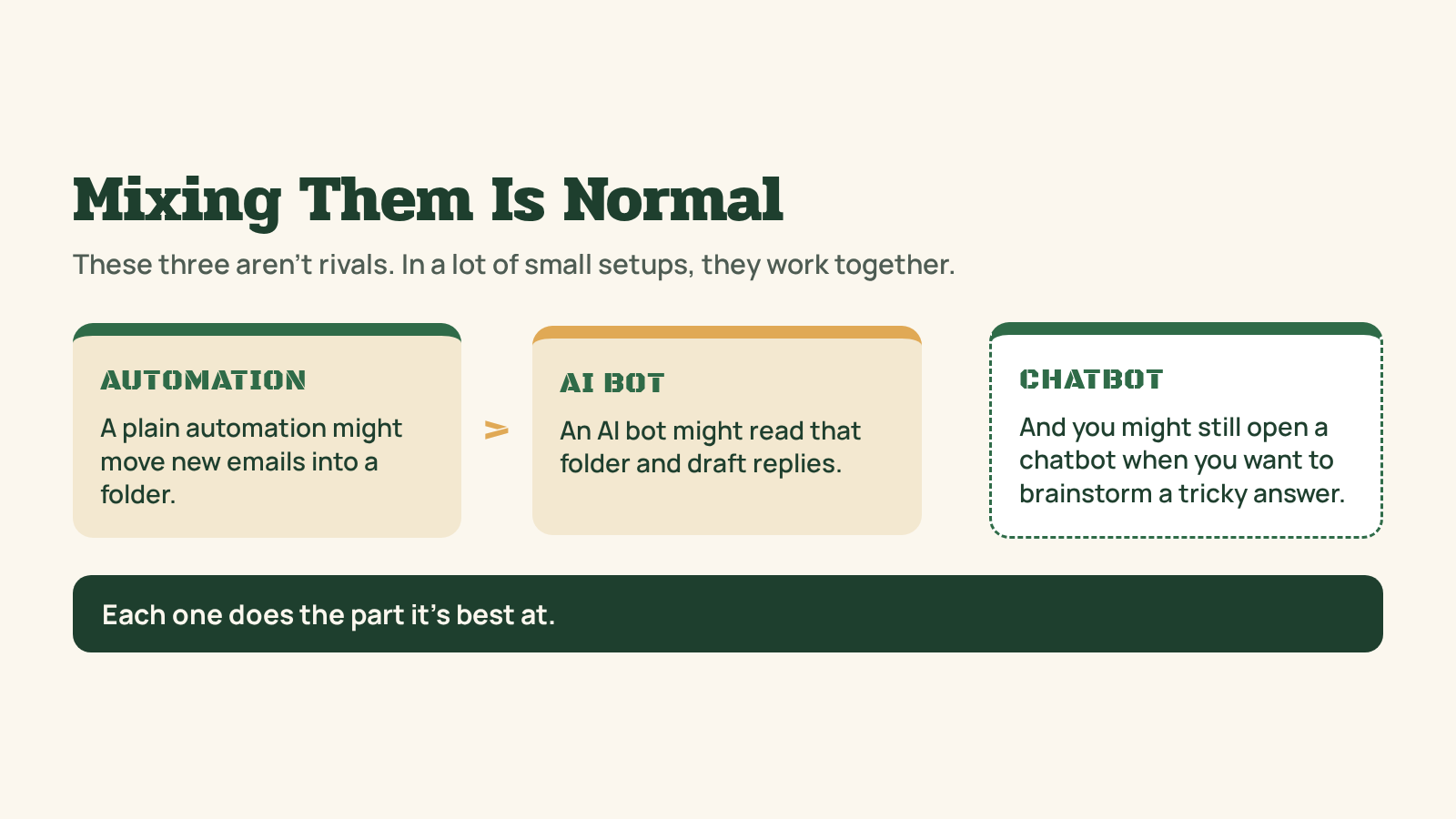
These three aren't rivals. In a lot of small setups, they work together.
A plain automation might move new emails into a folder. An AI bot might read that folder and draft replies. And you might still open a chatbot when you want to brainstorm a tricky answer. Each one does the part it's best at.
If you start with the simplest tool that fits and only reach for more when the job calls for it, you'll spend less time fixing things that didn't need to be complex.
How to Pick
Ask yourself three questions:
- Is the task the same every time? Start with plain automation.
- Do you mostly need answers, ideas, or a first draft? A chatbot will probably do.
- Is it a repeated job with a few steps that need some judgment? That's where an AI bot earns its keep, with you approving the results.
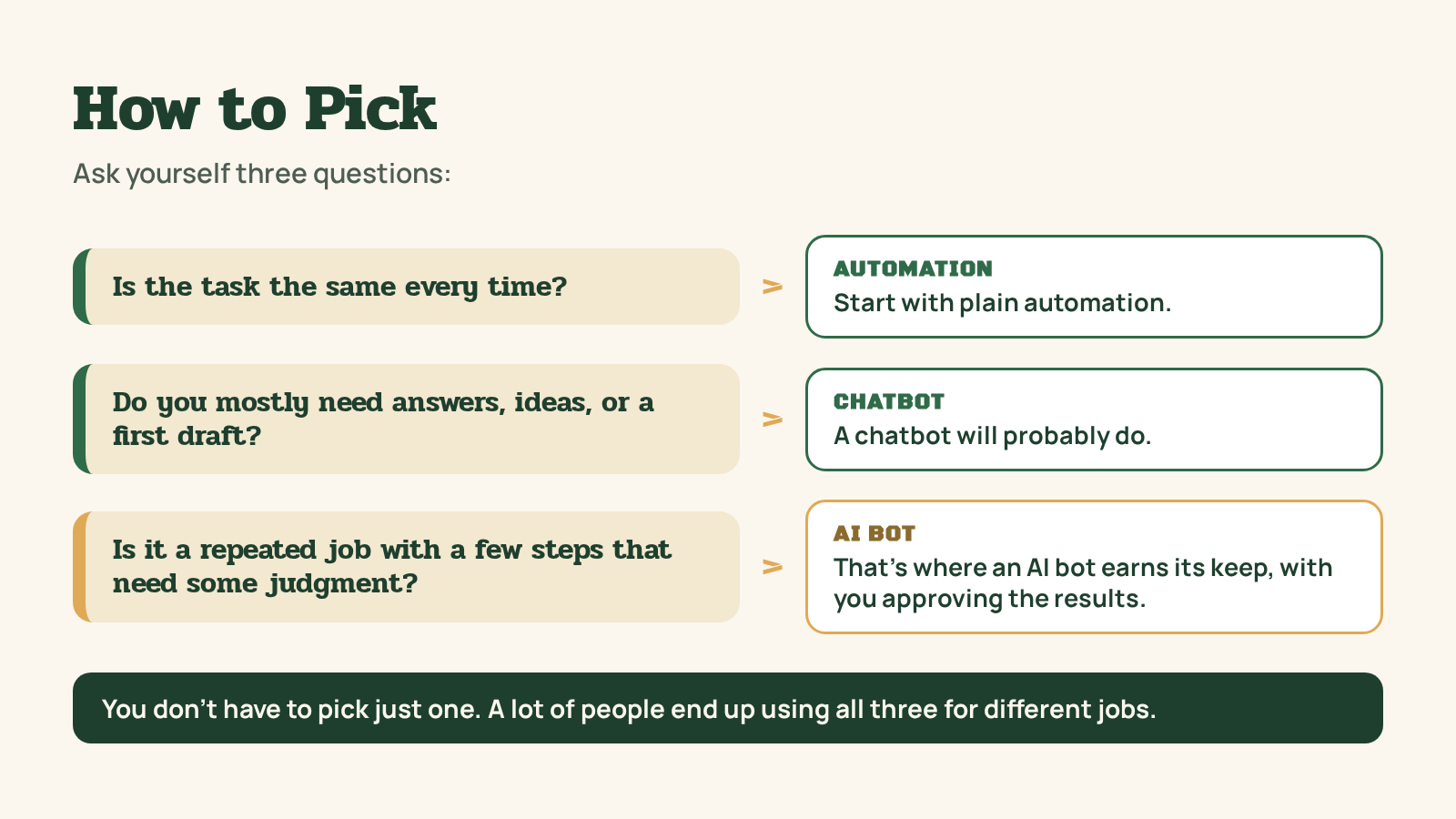
You don't have to pick just one. A lot of people end up using all three for different jobs.
The takeaway: Automation follows rules. A chatbot answers. An AI bot works through a job with the tools you give it. The more a tool can do on its own, the more your rules matter.
Your Next Step
Pick one task that's been eating your week. Run it through the three questions above. You might find you don't need anything fancy at all.
If you're deciding which job to hand off first, start with What to Automate First in a Small Business, and What to Never Automate.
Here's my question: which of the three are you already using, maybe without calling it that?


Comments ()