
How to Get Dramatically Better Results from AI on Real Projects

The 6-Part Prompting Framework
How to Get Dramatically Better Results from AI on Real Projects
Most people get mediocre results from AI. They ask a question, get back something generic, overly long, or off-target, and then feel frustrated.
The problem usually isn’t the AI.
It’s that most of us were never taught how to give clear, structured instructions.
This guide introduces a simple, repeatable framework that consistently produces much better results. It works for almost any type of project — planning, writing, researching, learning, or making decisions.
Why Most Prompts Fail
When you give AI a vague request, it has to guess what you actually want. This usually leads to one of two outcomes:
- A shallow, generic answer that doesn’t really help
- A long, scattered response that leaves you more overwhelmed than when you started
Both outcomes waste time and mental energy. The solution is to stop giving AI vague requests and start giving it clear structure.
The 6-Part Prompting Framework
This framework has six simple parts. You don’t need to use every single one every time, but the more complete your prompt is, the better your results will be.
| Part | Purpose | Why It Matters |
|---|---|---|
| Role | Tells AI who to be for this task | Prevents generic answers |
| Goal | Defines what success looks like | Keeps the response focused on the real outcome |
| Context | Gives relevant background information | Reduces bad assumptions and unnecessary explanations |
| Constraints | Sets clear boundaries on what to avoid or respect | Prevents unhelpful suggestions |
| Output Format | Specifies exactly how you want the response structured | Makes the output immediately usable |
| Next Step | Clarifies what you need right now | Creates momentum and reduces overwhelm |
Before & After: A Real Example
Here’s what this looks like in practice.
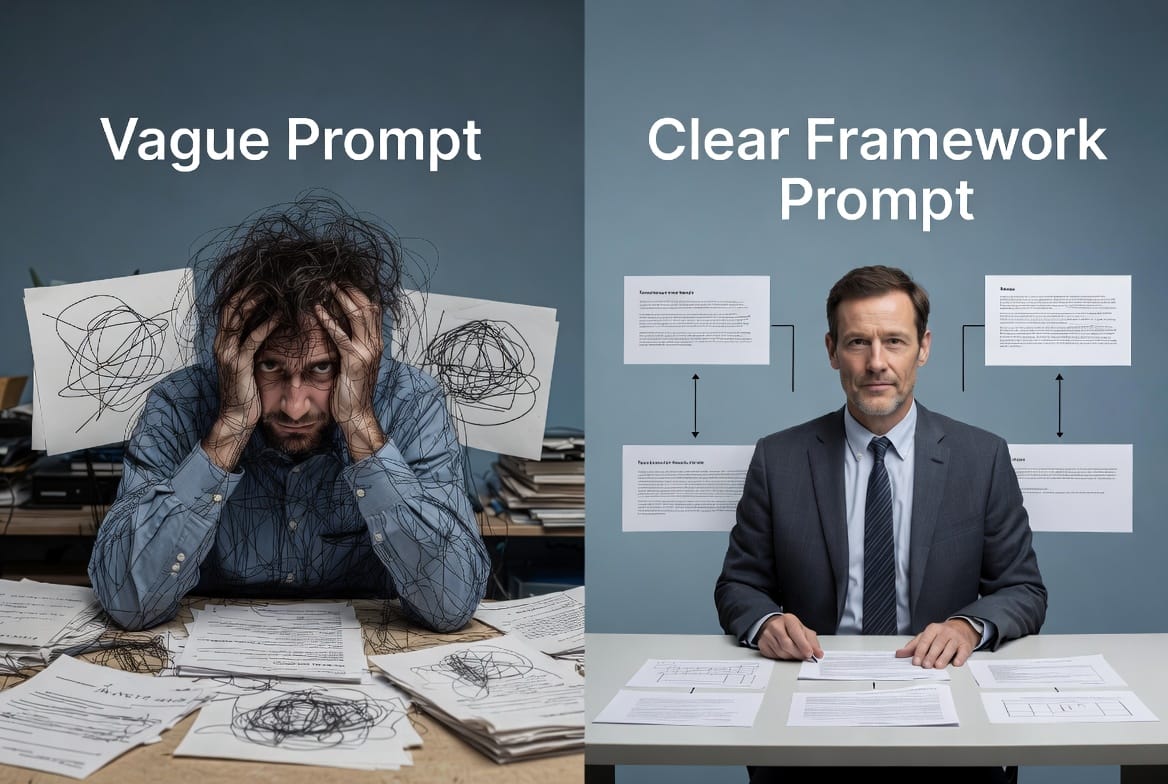
Vague Prompt (Common Approach):
“Help me launch a side project.”
What you typically get back:
A long, generic list of 15 things you “should” do, with no sense of priority, timeline, or what actually matters for your situation. You’re left more overwhelmed than when you started.
Well-Structured Prompt (Using the Framework):
You are an experienced project manager who specializes in helping busy people launch small side projects.

My goal is to create a realistic 30-day plan to launch a simple side project.

Context: I have a full-time job and only 5–7 hours per week to work on this. I tend to overcomplicate plans and then lose momentum.

Constraints: Keep the plan realistic and sustainable. Avoid anything that requires more than 5–7 hours per week. Do not suggest hiring help or spending significant money.

Output Format: Present the plan in a simple weekly format. For each week, include:
- The single most important action
- 2–3 supporting tasks
- A clear milestone

Next Step: I need help getting started. Focus only on what I should do in the first two weeks.
Well-Structured Prompt (Using the 6-Part Framework)
What you get back:
A focused, realistic plan with clear priorities, a manageable weekly structure, and an obvious starting point. Much more useful.
The difference isn’t magic. It’s structure.
Why This Framework Works So Well
This framework works because it removes the guesswork for AI and replaces it with clear direction. Here’s what’s actually happening under the surface:
- It reduces ambiguity. AI no longer has to guess your intent, your constraints, or what “good” looks like.
- It lowers cognitive load. You do the thinking upfront (defining role, goal, constraints), so AI can focus on execution instead of interpretation.
- It creates usable output. By specifying the format, you get something you can actually work with instead of a wall of text.
- It forces clarity. Defining the “Next Step” makes the interaction actionable instead of just informational.
- It trains better thinking. Over time, using this framework helps you get clearer about what you actually want before you even start prompting.
In short: better inputs create dramatically better outputs — and reduce the mental effort required on your end.
How to Start Using This Framework Today
You don’t need to master this all at once. Here’s a practical way to begin:
- Start small and simple
Pick one low-stakes task this week (organizing thoughts, planning a small project, or processing an idea). Use just 3 parts: Goal + Constraints + Next Step. - Copy and adapt
Take one of the templates below and change only what’s necessary for your situation. - Expect iteration
Your first prompt is Version 1. Most high-quality results come from 2–4 rounds of refinement. After you get a response, you can say: “That’s helpful. Now refine it with these adjustments…” - Notice what helps most
After a few uses, pay attention to which parts of the framework make the biggest difference for you. Double down on those.
Quick-Start Mini Template (Copy & Use Today):
You are [Role].

My goal is [what success looks like].

Context: [relevant background].

Constraints: [what to avoid or respect].

Output Format: [how you want it structured].

Next Step: [what you need right now].
Common Mistakes to Avoid
- Being too vague (“Help me with my project”)
- Skipping constraints (then getting suggestions that don’t fit your situation)
- Expecting perfection on the first try
- Forgetting to define the very next step (leaving you with ideas but no clear starting point)
- Treating prompting as a one-shot process instead of an iterative conversation
Final Thoughts
The quality of AI’s responses is largely determined by the quality of your instructions. The 6-Part Prompting Framework gives you a simple, reliable way to give better instructions — without needing to become a prompting expert.
Start using it on small tasks first. Get comfortable. Then apply it to bigger, more important projects. Over time, you’ll get significantly better results with less mental effort.
The goal isn’t perfect prompts.
The goal is spending less energy getting useful answers — so you can focus on the work that actually matters.
Ready to try it?
Pick one task you’ve been putting off and use the Quick-Start Mini Template above. See what happens.



Comments ()